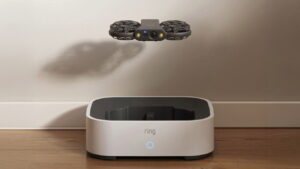
Science fiction has long imagined autonomous drones patrolling environments, investigating events and providing surveillance from the air. Movies such as Blade Runner 2049 and Oblivion depict worlds where flying drones provide surveillance and situational awareness.
What once seemed futuristic is beginning to look considerably more familiar.
Ring is bringing a practical, consumer-friendly version of that concept into the real world with Ring Robotics, a new generation of security devices designed not just to monitor an environment, but to move through it, investigate activity and respond autonomously.
Meet Ring Robotics
Ring Robotics launches with two very different devices:
- Ring Drone Cam, an autonomous flying indoor security camera designed for the home.
- Ring Rover Cam, a ground-based autonomous security robot designed for businesses.
Both integrate with the existing Ring ecosystem, including cameras, doorbells, sensors and alarms. The key difference is mobility. Rather than relying exclusively on fixed cameras, Ring Robotics introduces mobile, autonomous monitoring and incident investigation
A Security Camera That Can Fly
At only 165 grams (5.8 oz), including its battery, the Ring Drone Cam is remarkably lightweight. Its purpose is simple: provide security visibility in areas where you don’t have, or don’t want, permanently installed cameras.
Instead of mounting an indoor camera in every room, one autonomous camera can leave its dock and travel to different parts of the home when needed.
That means:
- No permanent camera required in every room
- No wiring between rooms
- No wall mounting of multiple cameras
- Predefined autonomous patrol routes
- On-demand deployment when you want to inspect an area
- Automatic investigation when a connected Ring security device is triggered.
It is less a traditional camera with propellers and more a mobile security sensor.
AI Pilot Provides the Intelligence
At the heart of the system is AI Pilot, Ring’s autonomous navigation technology.
During setup, the Drone Cam can be carried through the home as it learns the environment and develops a floor plan. AI Pilot can identify rooms, recommend useful patrol points and calculate routes between them.
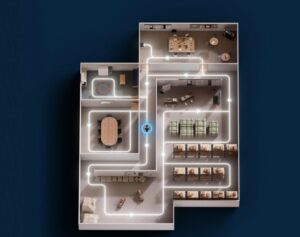
Once configured, AI Pilot combines cameras, specialized computer-vision models, on-device sensors and cloud processing to:
- Map the environment
- Identify rooms
- Suggest patrol points
- Calculate efficient flight routes
- Navigate autonomously
- Detect and avoid furniture and other obstacles
- Respond to events from other Ring devices.
This is where the product becomes considerably more interesting than simply putting a camera on a small drone.
2K Video From the Air
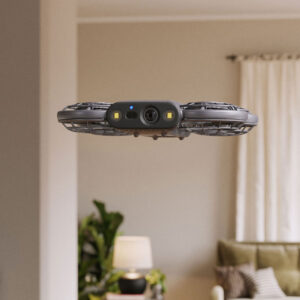
Despite its compact size, the Ring Drone Cam captures 2K 1920 × 1920 video and provides a 148-degree horizontal and vertical field of view.
It also incorporates LED spotlights that allow it to operate in darker indoor environments.
One particularly interesting privacy decision is the absence of traditional audio surveillance. Published specifications indicate the Drone Cam does not have a microphone or speaker.
Connected to the Smart Home
The Ring Drone Cam supports dual-band 2.4 GHz and 5 GHz Wi-Fi and WPA2/WPA3 wireless security. Ring recommends at least 5 Mbps upload bandwidth for optimal performance, with approximately 10 Mbps associated with 2K video.
It also works alongside existing Ring cameras, doorbells, sensors and alarms and can be controlled through the new Alexa Home Map.
What About Privacy?
An autonomous camera capable of flying around your home naturally raises privacy questions, so Ring has incorporated several visible safeguards.
When the Ring Drone Cam is sitting in its dock, the device powers down and its camera is off. The camera becomes active when a flight is initiated, and an LED indicates when recording is occurring.
Video is also protected using Ring’s Throw Away the Key encryption (TAKE), which the company describes as its strongest default video encryption to date.
Interestingly, the drone isn’t designed to operate silently. Ring explicitly notes that its propellers can be heard, making it obvious when a flying camera is present.
There’s a Trade-Off: Flight Time
This isn’t a drone that’s going to spend hours continuously flying around your home. That’s not necessarily a limitation in the traditional sense. The Drone Cam isn’t designed for continuous aerial surveillance. Its operating model is essentially:
Dock → Launch → Investigate → Capture Video → Return to Dock
The Ring Drone Cam provides up to approximately eight minutes of flight time per charge under controlled testing conditions.
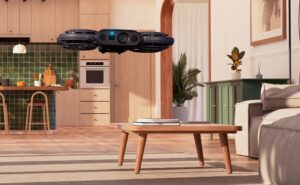
Science fiction envisioned autonomous machines watching over our environments. We’re obviously nowhere near the fictional worlds of Blade Runner 2049 or Oblivion, but a 165-gram autonomous security drone launching from a dock to investigate an alarm in your home suggests that at least one small piece of that future has arrived
Features and Specifications
- Dimensions (Ring Drone Camera): 6.76 × 5.39 × 1.31 in. / 17.2 × 13.7 × 3.3 cm
- Weight (Ring Drone Camera): 165 g / 5.8 oz including battery
- Dock dimensions:63 × 9.19 × 3.08 in. / 27.0 × 23.4 × 7.8 cm.
- Battery: Rechargeable lithium-ion battery;
- Flight time: up to 8 minutes per charge under controlled test conditions.
- Connectivity: Dual-band 2.4 GHz + 5 GHz Wi-Fi; 802.11 b/g/n
- Privacy: Camera is off when docked; recording begins when flight is triggered; LED indicates recording status
- Camera / video: 2K (1920 × 1920) video with a 148° horizontal and vertical field of view, supplemented by onboard LED lighting for low-light environments
- Smart Home Connectivity: Integrates with existing Ring Cameras, video doorbells, sensors, alarms; Alexa Home Map
- Availability: January 2027
For more information or to purchase the Ring Drone Cam
About Ring Robotics
Our mission is simple: make neighborhoods safer. As a smart security company, we strive to make safety and peace of mind accessible to everyone and empower communities to work together for one another.